
Mandatory signs use a white pictogram on a blue background to show which behaviour or which item of personal protective equipment is required in a given area. This category includes signs for hard hats, safety glasses, hearing protection, gloves, safety footwear, high-visibility clothing and more, available as rigid signs and self-adhesive stickers in several sizes. Pictograms based on the ISO 7010 system are understood regardless of language, which makes them suitable for production halls, warehouses, construction sites and public institutions. Recognition distance and indoor or outdoor placement both affect the right choice. Exact size, material and format are listed on each product page.





What is a mandatory sign?
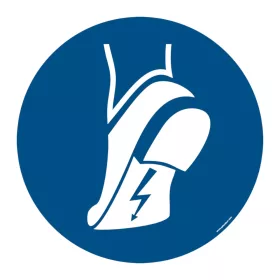
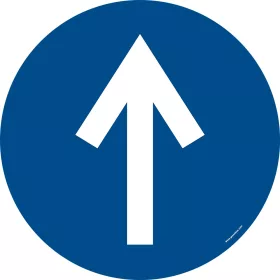
A mandatory sign is the type of safety sign that requires a specific action. It does not warn of a hazard and it does not prohibit anything – it states what has to be done in the area concerned. This is why its appearance is standardised and easy to recognise: a circular sign, blue background, white pictogram. The visual code allows the message to reach employees, visitors and contractors at a glance, even when they do not speak the local language.
In practice, a mandatory sign rarely stands on its own. It usually translates the outcome of a risk assessment into something visible on site: where a risk can be controlled by wearing protective equipment, the sign serves as a reminder of that requirement.
What behaviour can a mandatory sign require?
Use of personal protective equipment
- head protection: hard hat or safety helmet
- eye and face protection: safety glasses, face shield
- hearing protection: earmuffs or earplugs
- respiratory protection: half mask, respirator
- hand protection: protective gloves
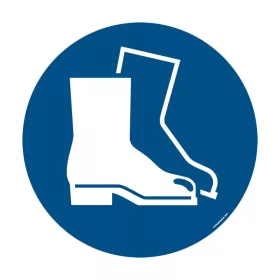
- foot protection: safety shoes or safety boots
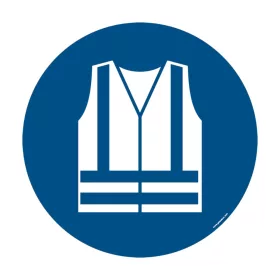
- body protection: protective clothing, high-visibility vest, apron
- work at height: fall protection equipment
Other required behaviour
- hand washing and disinfection
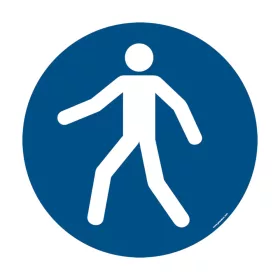
- use of the designated pedestrian walkway
- disconnecting the power supply before maintenance
- use of handrails, guards or safety devices
- entry only with authorisation or by trained personnel
- reading the instructions before starting work
The full range of available signs can be reviewed in the product list, where the pictogram and wording are shown on every product page.
Where are mandatory signs used?
Anywhere the use of protective equipment or a specific behaviour is not self-evident to someone entering the area. Typical locations include:
- production halls, machine lines and machining areas
- warehouses, forklift traffic routes and loading bays
- construction sites, site compounds and demolition areas
- maintenance and repair workshops, boiler rooms, electrical rooms
- laboratories, chemical stores, paint booths and welding stations
- hygiene zones in food processing plants
- technical rooms in institutions and office buildings
Entry points deserve particular attention: gates, doors, changing room exits and zone boundaries. A sign only does its job if it is seen before the person reaches the hazard area, not after.
Consistent appearance under ISO 7010
The purpose of the international standard ISO 7010 is to keep the shape, colour and pictogram of safety signs identical across countries. Within this system, mandatory signs carry reference codes beginning with the letter "M". Across the European Union, minimum requirements for safety and health signs at the workplace are set out in Directive 92/58/EEC, implemented in national legislation, and the sign system used in practice is built on the same set of symbols – which is why the signs available on the market share a broadly consistent visual language.
The practical benefit is that on multilingual sites, where contractors come and go, and across several locations of the same company, the meaning stays the same. Information about the standard compliance of any individual product should always be interpreted on the basis of the details given on that product page.
Sign or sticker? Choosing the format and material
- Self-adhesive sticker: for smooth, clean and dry surfaces such as machine housings, doors, cabinets and covers. Quick to apply, takes up little space and is cost-effective in smaller sizes.
- Rigid plastic or foamed PVC sign: for walls, posts and fences, where there is no suitable surface for adhesive or a larger size is needed. Fitted with mounting holes or double-sided tape.
- Metal sign: for durable outdoor mounting and locations exposed to heavy use.
- Photoluminescent version: appropriate where the sign needs to stay visible during a power failure or in poor lighting.
Indoor and outdoor use
Indoors, the main considerations are the mounting surface and how easily the sign can be cleaned. Outdoors, UV resistance, moisture resistance and tolerance to temperature changes become important, so a weather-resistant material is the safer choice – print not intended for outdoor use may fade over time. The intended application of each product can be checked against the details shown on the product page.
Size, visibility and placement
Size is a functional matter rather than an aesthetic one: it needs to match the recognition distance. The further away the sign has to be noticed from, the larger the pictogram must be. An entry point to a large hall calls for a different size than a machine housing.
- mounted at eye level, free of obstructions
- placed before the hazard area, not inside it
- adequate lighting and an unobstructed line of sight
- not covered by stock, an open door leaf or storage equipment
- checked regularly for cleanliness, fading and lifting edges
Common applications
- high-visibility vest and safety footwear signs at warehouse gates
- safety glasses and hearing protection signs in front of machine lines
- hard hat signs at construction site entrances
- isolation and lockout reminders at electrical cabinets
- hand washing signs at the entry to food production zones
- pedestrian walkway signs along internal traffic routes
Find the sign that fits the site
The product list can be browsed by pictogram, size and format. It is worth reviewing all entry points of a site in one pass and replacing missing or worn signs together – this makes installation simpler and keeps the signage system consistent. For questions about the most suitable format, our team is available to help.
Frequently asked questions
What does a round blue safety sign mean?
It requires a specific action. The white pictogram on a blue background shows what has to be done, or which protective equipment has to be worn, in that area – as opposed to prohibition signs, which forbid an action, and warning signs, which draw attention to a hazard.
What size should be chosen?
Size should match the distance from which the sign needs to be recognised. A smaller size is usually sufficient for a limited mounting surface, a machine or a door, while a larger size is appropriate in a high-ceilinged hall or outdoors.
Is a sticker or a rigid sign the better choice?
A sticker works well where there is a smooth, clean surface suitable for adhesive. A rigid sign is preferable where the surface is uneven or dusty, where mounting is on a post or fence, or where the sign may need to be relocated later.
Are these signs suitable for outdoor use?
This depends on the material and the print. Versions intended for outdoor use are generally made from UV- and weather-resistant materials. The intended application can be checked in each case against the details on the product page.
What is the difference between mandatory, prohibition and warning signs?
A mandatory sign requires a specific action (blue circle), a prohibition sign forbids an action (red circle with a diagonal bar), and a warning sign draws attention to a hazard (yellow triangle). Emergency escape and fire equipment signs form separate groups of their own.
Are custom sizes or custom wording available?
For custom size or custom wording requirements, please contact our customer service team, which can provide information on the available options and the expected lead time.